This time – about the problem which is not directly tied to diagnostics. Or – still is?
I believe that almost every B58 user has heard of the possible oil pump defect. What is it like?
In B58, the oil pumps with variable flowrate are used. The flowrate of the oil pump is changed in a way that the oil pressure corresponds to the one required by DME. What pressure does DME require? It depends on temperature, RPM, and required torque. Exact curves can be found in TIS; I will not paste them here.
Variable flowrate is ensured by the cylindrical part, which changes the geometry of the pump. For some part of the oil pumps (for example, the first years of Gen 2), this cylindrical part is made of plastic.
Here is how the oil pump looks after the damage:
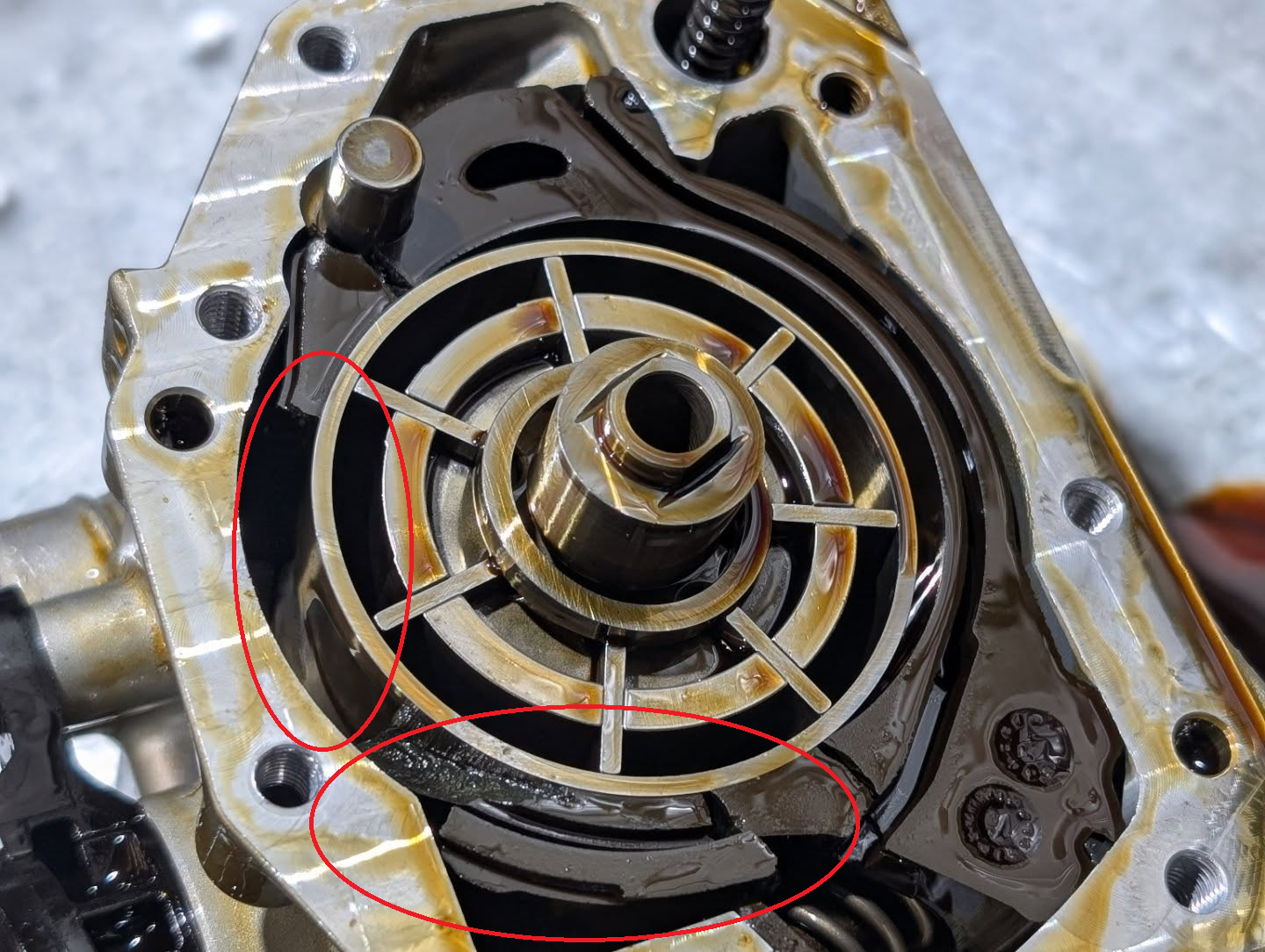
Disclaimer: The image is the intellectual property of WG Motorworks
What happened? Do fools work in BMW? Don’t they know the materials? I believe they know both materials and how to prognose their wear. The situation may be more interesting than it seems at first sight.
Before I switch to the analysis of the problem, a short basic info:
a. Symptoms of the problem: notices regarding reduced oil pressure;
b. It is not possible to measure the level of the oil in the engine.
Of course, in case of such symptoms, the engine must be shut down immediately, and the tow truck has to be called in. Good news – typically, such oil pump damage ends with a scare and pump replacement.
And now we switch to a more exact problem review.
If we assume that BMW does not employ complete fools (and it would be hard to embrace it), an interesting question arises – what went wrong? How does this plastic part brakes so…
In my mind, there is one obstacle, which may not actually be considered by the BMW engineers.
Start sequence for B58 engine:
a. before the start, the calibration of the oil pressure sensor Offset value is done (determination of 0 hpa/bar reference value);
b. a signal is being given to the oil pump management solenoid to develop maximum performance;
c. CAS supplies management voltage to the starter; it starts to crank the engine. At this moment, HPFP is activated (Rail pressure pumped up), but the injectors are not opened. The starter cranks the engine, but the engine is not started;
d. DME controls the oil pressure. As soon as it is detected that the oil pressure is >0, DME allows the start of the engine – the injectors are opened, the fuel is ignited, and the engine is started;
e. if during 5 seconds the oil pressure is not identified, the engine is started, but the electronic oil pressure control is switched off. The oil pump works with maximum flowrate; the oil pressure (in larger RPMs) is limited by the mechanical overpressure valve;
f. if during 5 seconds DME detects a positive oil pressure, it allows the engine to be started. In addition, DME immediately starts to regulate the oil pressure in accordance with its (pressure) management maps. This is a standard situation.
Here I would like to note a number of (in my opinion) important nuances:
a. in the situation, when the oil pressure was not identified during 5 seconds, Siemens DME directly after start (when reaching idle) performed the test of the oiling system. For 1 .. 2 seconds, the oil pressure regulation valve was closed, checking the maximum oil pressure that can be developed by the pump. If this test was successful (typical pressure for correctly performing system: at least 5 .. 6 bar in idle), DME restored the “standard” management system – oil pressure management by maps;
b. If, during 5 seconds, the positive oil pressure is not reached, Bosch DME starts the engine, but the oil pressure management is switched off, relying on the overpressure valve. When the “standard” management method is restored? BMW keeps silent on this (as for other nuances mentioned in this blog entry), possibly by timer; when reaching the next temperature segment; starting a new driving session. I did not try to perform the experiment with a customer’s (not even my own) car, by imitating zero oil pressure. And, what could be even more important – it also doesn’t matter. Such an emergency mode is not acceptable!
c. in case of Siemens DME, there are seen error messages regarding oil pressure at the moment of the engine start (in the attributes around 200RPM, provided by the starter, can be seen), but Bosch DME, on the contrary, does not record error messages regarding non-existing oil pressure at the moment of the engine start!
d. the mechanical overpressure valve ensures the limitation of the maximal pressure in the range of 10 .. 12 bar (exact values in the case of your engine you can find in TIS). It is at least 2 times more than in the case of electronic management. Even 3 .. 5 times more than at the moment of the cold start, in idle.
Why do I speak so much of the engine start and the oil pressure emergency management mode? If, for some reason, DME switches off the electronic pressure management system, of course, the oil pump has a much larger mechanical load. The harshest situation will be in the conditions of the cold start (and in lowered/winter temperatures) because the oil is thicker than it should be, and the oil filter is partially clogged.
Summary – how to kill the oil pump:
a. use “alternative” oils (starting – there is no need to spend a lot of money on the oil, finishing with – I read on the Internet, that these bio/racing/mega oils are the best);
b. Change the oil as rarely as possible; it will be cheaper. After each 30.000km, driving in the city – that’s the way to go! You can not even hurry to the maintenance – 40.000km is also a very acceptable oil change interval!
c. use the cheapest oil filters. Every saved EUR 5 is EUR 5!
d. don’t follow the oil level. If the car says that the oil level is low, do not add 1 liter as the car requires. Add just a little bit, it surely will “pull” until the oil change. The leftover oil will be excellent for many more such additions!
e. ignore longer/unstable (in the meaning of cranking time) starts! It’s a small thing – the most important thing is that the car has started! It is advisable to rev a cold engine!
f. when performing the maintenance, do not clean oil dirt and debris, never clean the oiling system, don’t check the backvalve under the oil filter. If you perform any repair of the engine, definitely don’t check the oil sump; never replace the oil pump management valve. These are just unnecessary expenses!
g. if the car has misfires, more – don’t stress. The oil diluted with fuel is still only oil!
h. when performing diagnostics, don’t look at the live data regarding oil pressure! There is nothing interesting to see!
I think you got my sarcasm. Of course, you should do exactly the opposite!
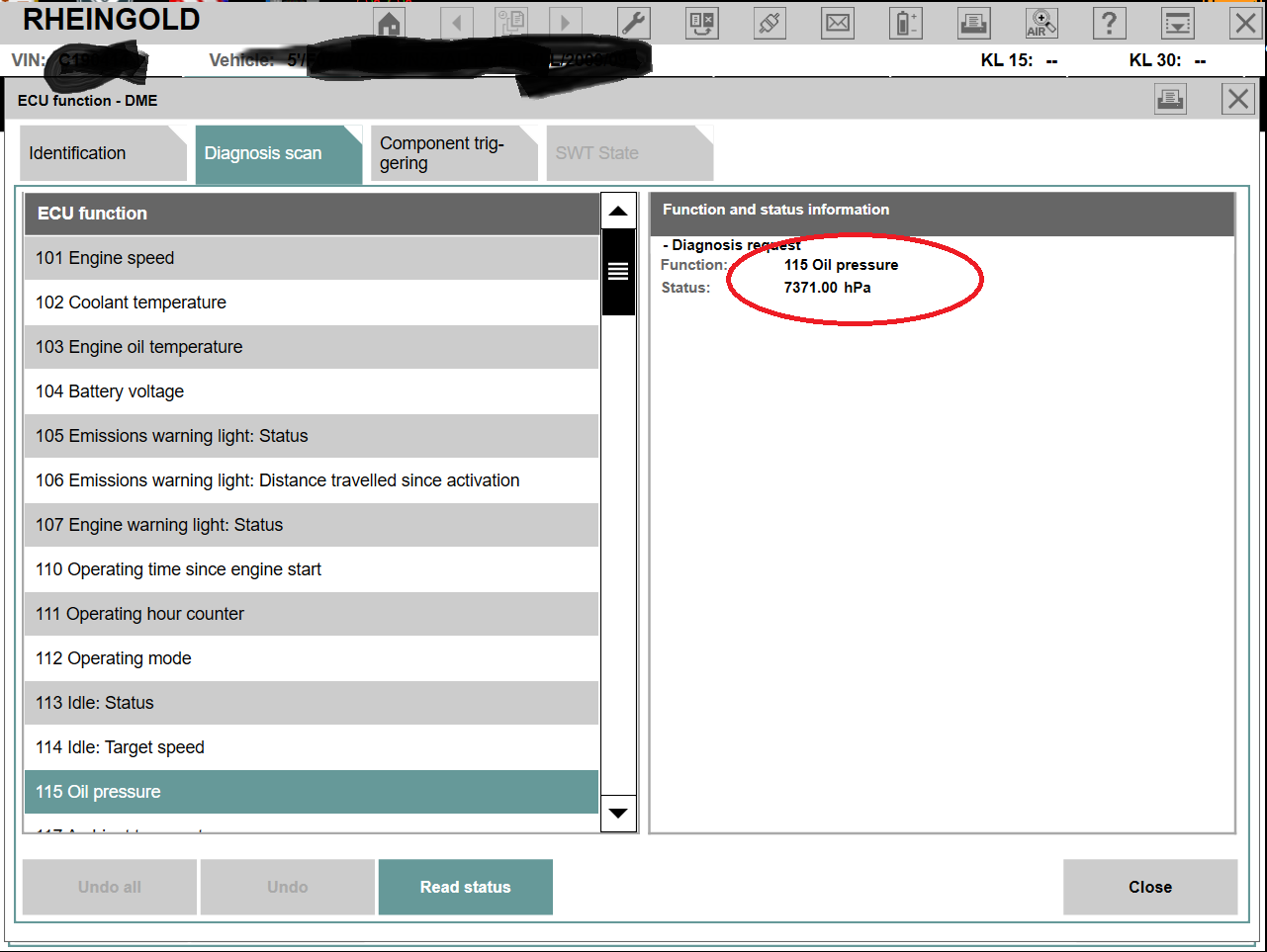
Here’s how the Bosch DME cold start in emergency mode looks: around 7 bar in idle. Electronically managed pressure is typically much lower:
a. around 2.6bar for the engine in work temperature;
b. increases to 3.0 .. 3.2bar for the cold engine (in the temperatures around -20oC).
Summarizing all of the above – I assume that exactly the start problems (use of oil pressure emergency mode) is the main reason why the oil pumps are getting damaged. Inappropriate, old, thick oil (or exactly the opposite – too liquid oil, damaged check valve – the oil leaks in the crankcase, is not absorbed in time); partially clogged oil filter; revving of the cold engine (the car started reluctantly – revving is the first idea that comes to mind, right?).
Here we have to “throw the stone” in the Bosch (or – BMW AG as the customer) “garden”. All possible is done:
a. no error messages are recorded regarding the not-reached oil pressure;
b. the oil pressure electronic management is not immediately restored after confirmation that the oil pressure is sufficient/with a reserve;
c. RPM of the engine and/or required torque is not limited.
Yes, of course – the iron cylindrical part “solves” the problem – the pump does not “die”, but the main problem does not go anywhere!
