
Select a technical image to view it in detail.
An owner of a car with an N43 engine came to me after a repair that went wrong. He had run the diagnostics himself and found that the injectors of cylinders No. 3 and No. 4 were leaking when closed. He replaced both with “professionally refurbished” units bought over the Internet. Unfortunately, the car was in even worse shape afterwards.
Symptoms after the repair
The EML (Check Engine) light is permanently on in the instrument cluster (KOMBI). The DME fault memory contains fuel mixture errors for both banks, and a cylinder is regularly switched off, among other entries.
I won’t burden you with the complete data set. This time I’ll show only the injector adaptations, which are the most telling.
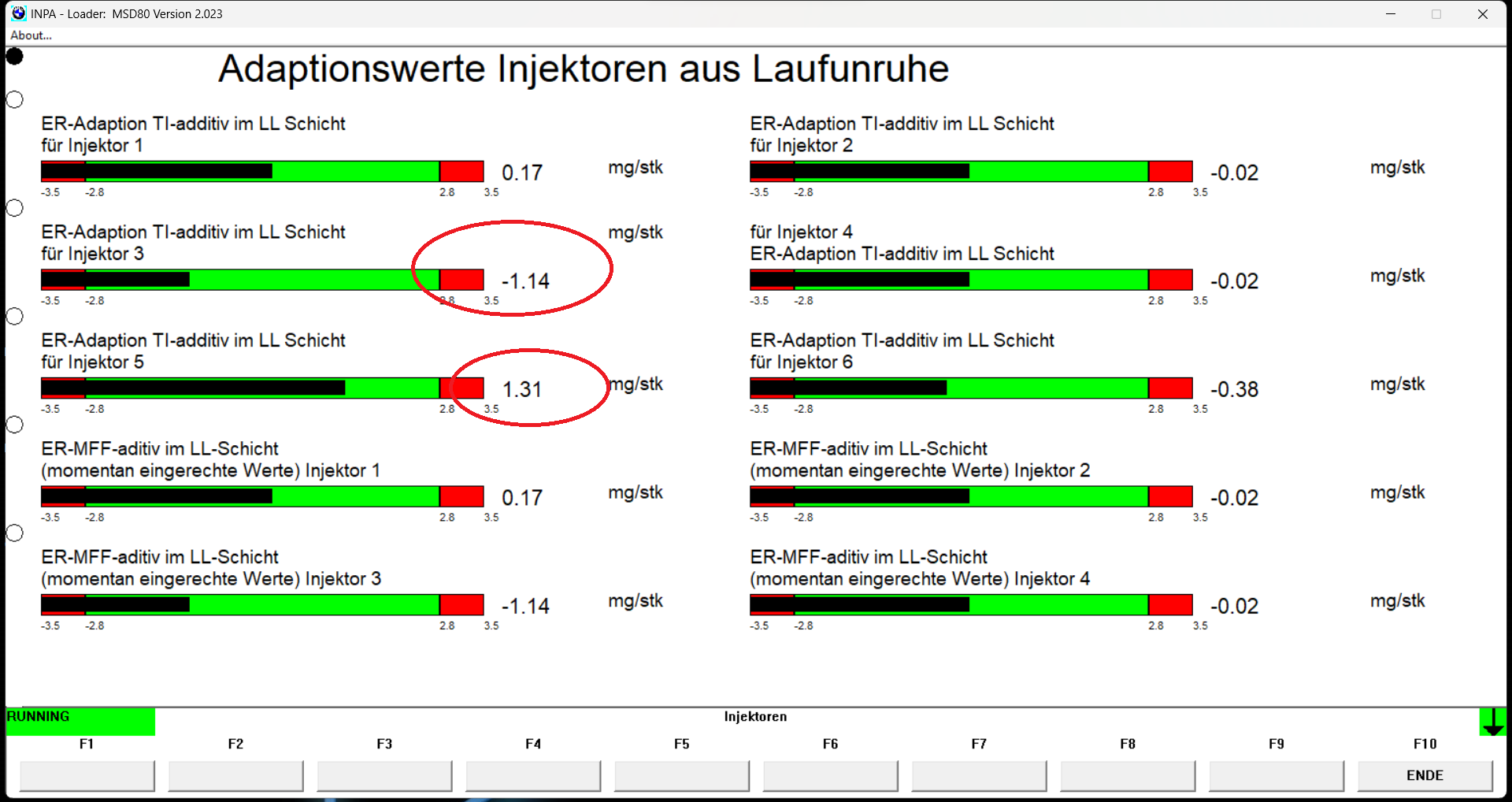
This is idle in stratified charge mode. The injector of cylinder No. 4 is leaking strongly. The injector of cylinder No. 3 atomizes very poorly: it is not injecting the fuel but pouring it out.
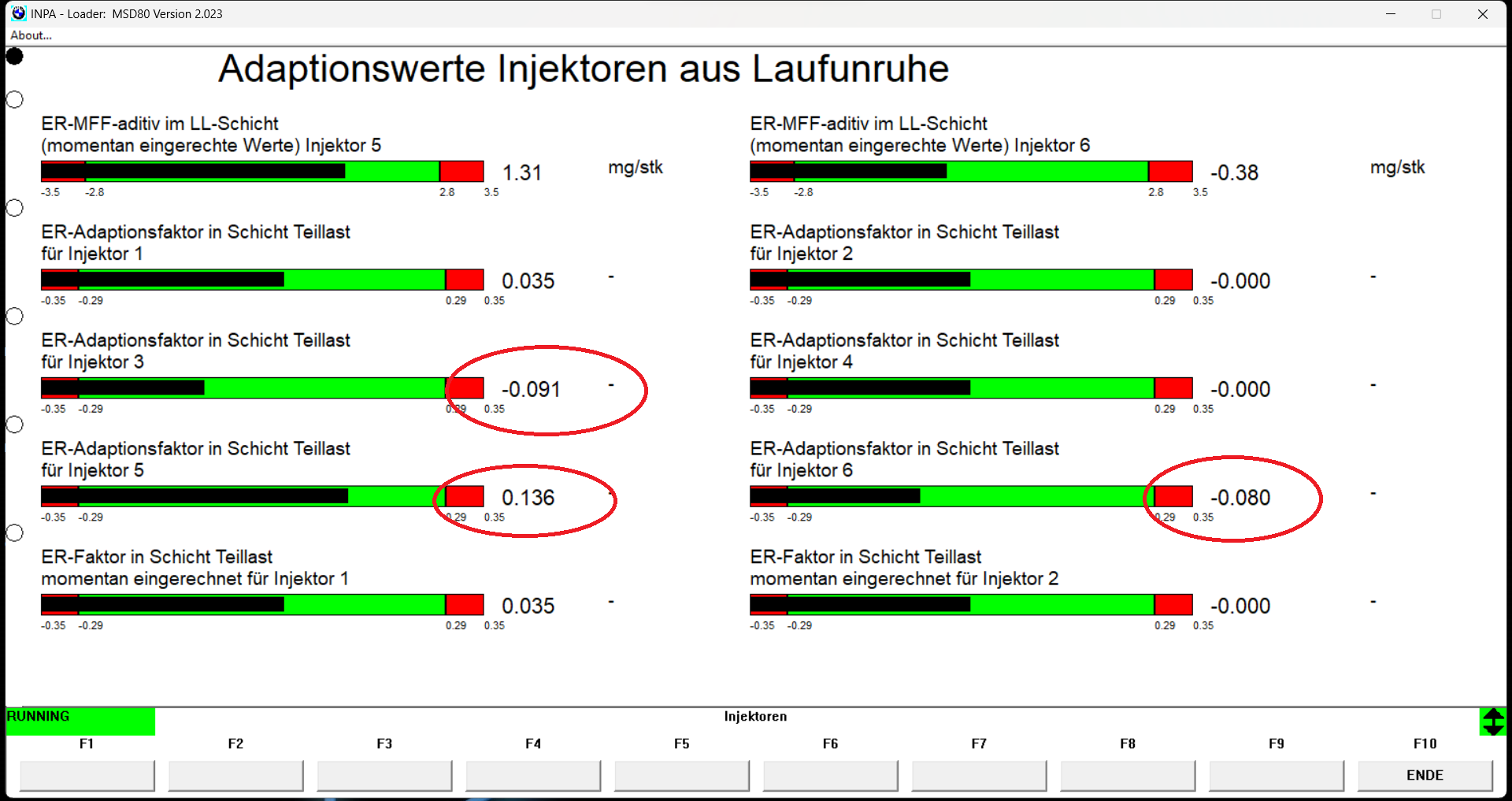
This is stratified charge at partial load. The largest deviations from the planned flowrate are again at cylinders No. 3 and No. 4.
It is clear that these “refurbished” injectors are unusable. The flowrate deviation reaches 30 to 40%. At idle, the DME has to shorten or lengthen the injection pulses by a factor of 2 to 3 just to get a roughly correct mechanical efficiency from the cylinders. In homogeneous mode the DME cannot even out the mixture at all. Because of the specifics of its algorithms, adaptations are created much more slowly in this mode. The result is open loop operation, switched-off cylinders and so on.
The injectors themselves
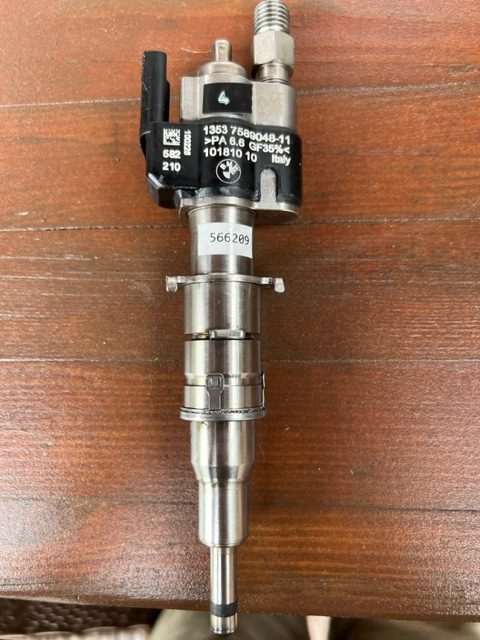
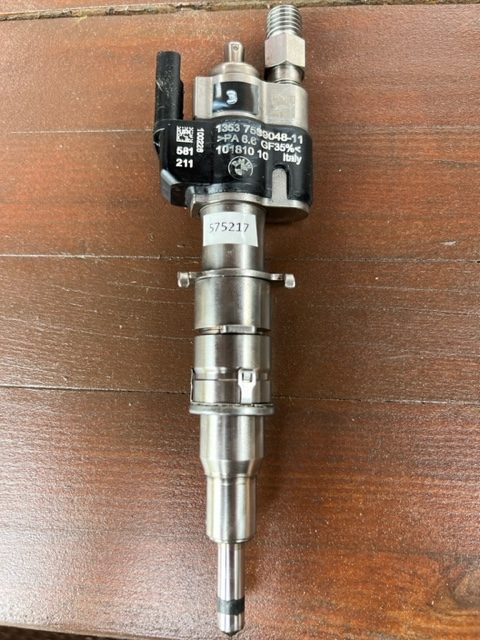
Both injectors appear convincing at first glance:
- They have black bodies.
- They appear to have been manufactured in 2010.
- They are the latest, 11th release.
- The printed fonts more or less match the originals.
However:
- The 11th release was not manufactured in 2010.
- The 11th release never came in black bodies.
The conclusion is simple: these injectors are Chinese fakes.
The new encoding data
The story does not end with a simple counterfeit. Each injector carries a label with new, different encoding data, which supposedly confirms that it has been refurbished. Here are the old and new encoding data side by side:
- Cylinder No. 3: 211; 581 (old) and 217; 575 (new).
- Cylinder No. 4: 210; 582 (old) and 209; 566 (new).
Do the new values correspond to the parameters of these injectors? Of course not. Are they at least “closer” to the truth? Let’s see.
- Delay: The differences (211 vs 217 and 210 vs 209) are close to zero. By the encoding data, the delay of each injector is practically unchanged, and for one injector the values even coincide. In reality the difference is more than double.
- Flowrate: The differences are slightly larger (581 vs 575 and 582 vs 566), but the new encoding data still imply a tiny change from the original. The largest difference is 2.7%. The actual situation shows a very different picture, with a 30 to 40% deviation.
The conclusion is harsh: the “new” encoding data are almost certainly fake. Nobody measured these injectors. Labels with more or less similar numbers were simply attached to imitate refurbishing.
Another “success story”. But why learn from the mistakes of others if you can make them yourself?