I should admit that there is a very small amount of (reliable) information regarding LSPI. Most often, the terms “unexplained phenomenon”, “the circumstances are being clarified”, etc., are used. Even the most reputable bloggers are citing two paragraphs of Wikipedia without deeper explanation. Now I will try to close this gap using scraps of information from the Internet and my physics knowledge.
In the first sentence, Wikipedia states that engine reductions are to blame. And here comes the first misunderstanding: B58 is a three-liter engine, where is the reduction?
Actually, the topic is slightly different. With each generation, the engine manufacturer “squeezes” more torque and power from the same capacity engine; at the same time, the demand for a higher efficiency ratio (lower fuel consumption) is only increasing. Accordingly, the LSPI problem concerns all high-power petrol engines, regardless of their capacity or number of cylinders. By “high-power,” I mean the turbo engines of the latest generations. For example, in the case of the B58 series engine, the parameters of “high-power” correspond:
a. compression 1:11;
b. boost pressure (in stock version with torque of 500 Nm) around 2.2 bar;
c. power and torque parameters (500 Nm in a wide range of PRM and 370 hp in the range of 5500 .. 7000 RPM);
d. full torque on the power bench, starting from 1100 RPM (on dyno), in real-life conditions from around 1500 RPM.
To understand how impressive these parameters are, we can compare B58 with, for example, S58 (or S55) series engines.
Compression 1:11 vs 1:9.3/1:9.5
Torque: 500 Nm from 1100 RPM vs around 250 .. 300 Nm in range to 2600 RPM (full torque from 2800 RPM) – compared power bench results. As we see, for the “everyday” engine B58, at low RPM, almost 2 (!) more fuel and air are injected (logically, since it develops 2 times higher torque). In addition, its compression is much higher!
By looking at these numbers, we have to conclude that B58 works under higher temperatures and pressures (in the combustion chamber) than S55/58! At lower RPM, the situation differs even more dramatically! What are the consequences of this?
B-series engines operate at such high temperature and pressure conditions that the fuel (even the average lean, even the very lean in the exact sector of the combustion chamber) needs the slightest “reason” to self-ignite. The reasons for such self-combustion can be:
a. any debris, micropart, which gets into the combustion chamber;
b. micro droplets of oil.
If any debris (micro impurity/hard fracture) gets into the combustion chamber, the high pressure and heated air can heat it so much (due to low RPM, it has time to heat up) that it ignites the fuel mixture.
If the oil gets into the combustion chamber, it forms microdroplets when rapidly heated, and they can ignite at the high temperatures. An ignited microdroplet ignites the fuel mixture, which, in turn, ignites other oil droplets.
Why have these LSPI problems become a problem, specifically in the B series (B58) engines?
a. high compression (1:11) in the combustion chamber;
b. high torque in low RPM.
Low RPM, high pressure, and a lot of air (sucked into the cylinder during high-torque preparation) result in very high temperatures for a long time. It means that both the microparticle that enters the combustion chamber and the oil microdroplets heat up so much that they self-ignite (oil droplets) or ignite even a lean fuel mixture (hard microparticle).
With hard microparticles, everything is clear – dirty fuel, individual accident. DME switches off the cylinder for several cycles, it vents, and the problem is solved.
More interesting (if we can use this word) is the case of oil microdroplets. For the microdroplets to cause problems, they have to enter the combustion chamber. The contributing factors here are:
a. thick oil;
b. increased oil level (problem of the last cylinder at the moment of rapid acceleration);
c. low engine temperature (increased air gap between piston and wall of the block).
The oil can get into the combustion chamber in the following ways:
a. if the oil rings “can not handle” the task – high oil level, thick (cold) oil, increased air gap between cylinder and block walls in low temperatures;
b. In low temperatures (due to increased air gap between cylinder and the block walls), the piston “shivers” when moving, which means it works as a pump that tries to pump the oil in the combustion chamber.
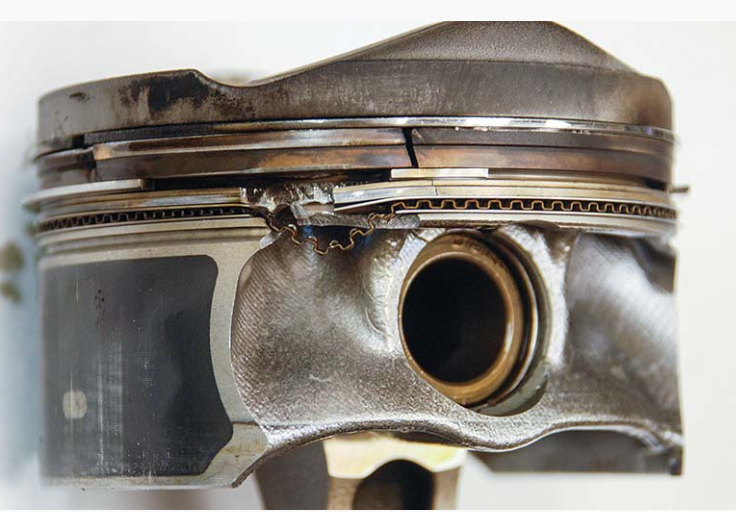
The oil film that passes the oil rings mostly settles on the block walls, but some of it gets to the middle part of the combustion chamber. BMW’s injection strategy provides that the richest fuel mixture is in the center of the combustion chamber, closer to the spark plug (BMW calls it “layer” injection strategy). Accordingly, if the microparticle or the oil microdroplet gets in this range of relatively richer fuel mixture, the fuel injected in the combustion chamber will ignite, even if the average fuel mixture in the combustion chamber is very lean (it means, at the same beginning of the injection phase). Ignited fuel will ignite other microdroplets (at this moment, the air has a large reserve, for the burning of the microdroplets is enough with the reserve: a large amount of the fuel is not yet injected). If the oil microdroplets ignite at the moment when the cylinder moves up in the compression phase (and exactly at the same moment the superknocking starts), the burning process of the oil microdroplets happens by the walls of the block (because exactly here the microdroplets are “stuck together”) and is “thrown” by the piston walls in the direction of the oil rings. The temperature in the area of the oil rings rapidly increases (there is a lot of oil to burn, and there is no reason for the lack of air either).
Significant overheating of the piston (close to the temperature of material melting) in the area of the oil rings in a set with high mechanical load (explosive pressure increase in the combustion chamber) creates damage to the side part of the pistons (which is typical – very often the “cap” of the piston stays intact).
In a “normal” detonation/knocking, the upper part of the piston is typically damaged. Here burns the largest part of the fuel (in case of a correctly aligned injector beam and atomization, the highest fuel density/burning energy is exactly at the center of the combustion chamber); here is the highest temperature and the kinetic energy of the burning process.
Instead, if the LSPI occurs and (what is important) this self-ignition is reinforced by oil microdroplets that are “stuck” to the block walls, the greatest damage is to the side of the cylinder. In this case, the fuel does not cause the greatest harm (in no way can the fuel “flow together” along the sides of the cylinder), but rather the burning of oil along the walls of the block!
It is not a secret to anyone that it is exactly the oil and oil microdroplets that cause the greatest problems. For this reason, oil manufacturers are pursuing API SP certification. To pass the API SP criteria, special additives are added to oil to reduce the LSPI risk. Exactly due to these additives, it is critically important to use oil specified for the exact engine.
A second aspect to avoid the consequences of LSPI is to avoid a large torque requirement at cold start (independent of RPMs).
