Every now and then, questions from B58 series engine users pop up on the internet – what exactly is wrong with those injectors? If we trust the community, they tend to get stuck in an open position. Without exception, every time, several tens of users share their experience. Some of them have had this happen to them (at least, they argue this). Some of them base their opinion (clear – yes, they stuck, yes – a popular defect) on clearly reliable sources. Of course, this reliable source is the internet.
I have never encountered this problem. In none of the diagnostic cases (even then, when I was approached with an already clear diagnosis – the injector stuck in open position), this defect was not confirmed. Many (dozens) times, I have tried to find out from those who have experienced these defects, I have tried to find out what the symptoms of this problem are, what evidence there is of exactly this defect. I got only one reply from an employee of a private workshop. This time, this example/case will be described.
First – the main evidence of the defect:
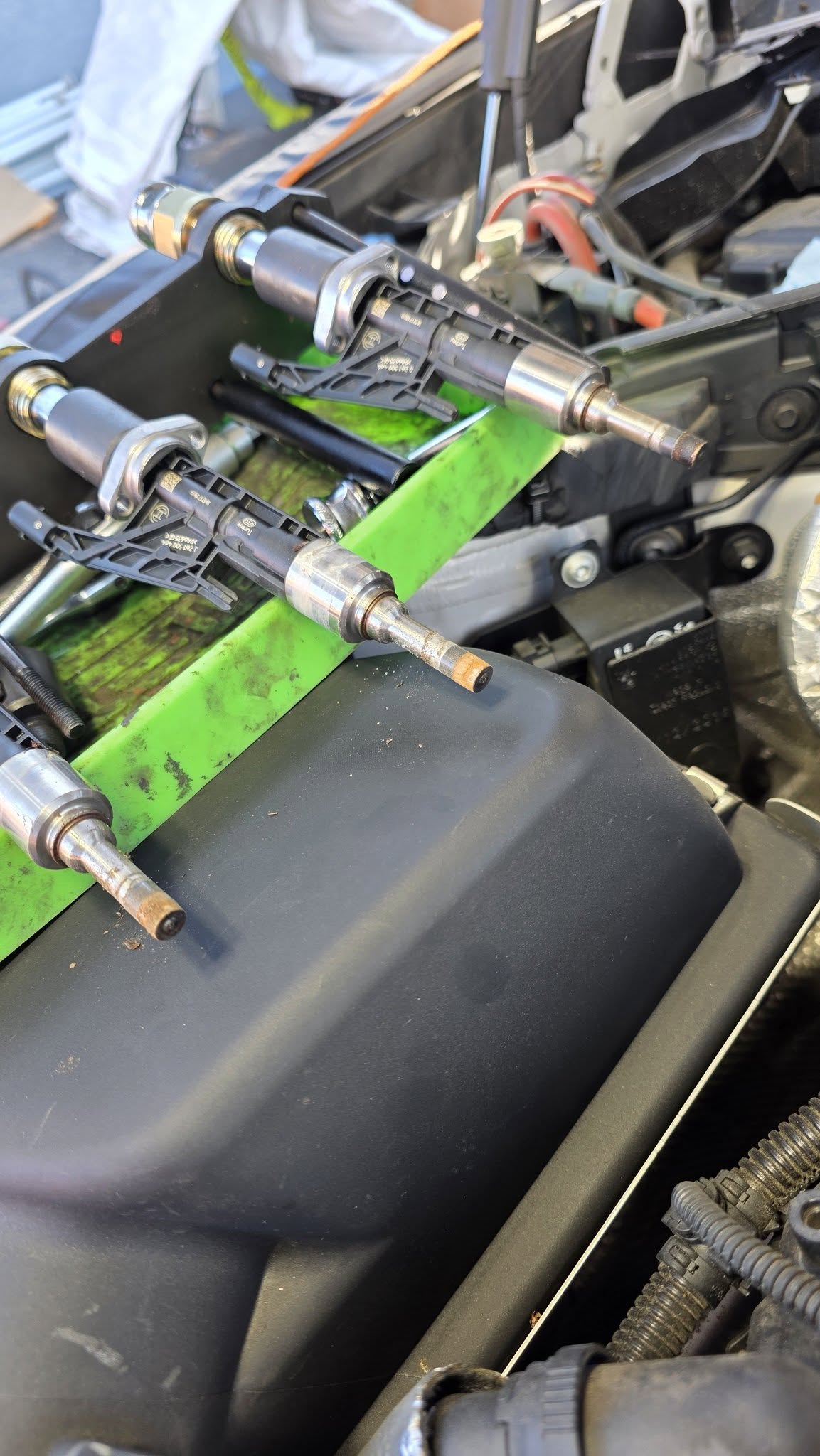
Here, the injector on the right side has a darker nozzle part. This is the culprit (as arguing the author of this photo). The most interesting is that this is the magic 6th injector again! Another coincidence?
When I asked the author of the image what exactly indicated that the injector was stuck in an open condition, he answered:
a. unburned fuel;
b. darker injector tip/nozzle part.
I have objections to the first one – unburned fuel will also be in the case of misfires (reason – Bosch DME has a problem with misfire detection, injection of the misfiring cylinder is switched off very late). Regarding the second, in the image, we can clearly see that the darker part of the injector is one, which is “submerged” in the head of the engine. The nozzle surface itself is of an identical color. Instead, the darker plaque of the nozzle part of the 6th injector can be explained by a regular replacement of this injector: after another cleaning of the block head shaft, the injector bore size has slightly increased. Accordingly, between the block and the injector, the burn/debris is accumulating.
The author of the image has an argument – the dark plaque is unburned fuel, which confirms the sticking of the injector in the open position. Here I have to ask – in those several (ok, let it be several tens) of seconds while the injector was pouring the fuel, the fuel squeezed into the gap between the nozzle and the engine head and turned into black deposits? In addition, the fuel was not ignited! In my opinion, something completely illogical! Rather, we could see how the fuel has washed away all the dirt/soot.
Another argument appears: many N54, N55, B-series engines have been repaired. And here I became careful. N54 engines have piezo injectors. Yes, these injectors really tended to get stuck in the open position. But, starting with N55, BMW went back to solenoid-type injectors. In my opinion, mentioning the N54 as an example is completely out of place and rather indicates a poor understanding of the topic by the author of the statement.
One more argument: I replaced the injector, and everything was fine. There are possible scenarios:
a. spark plugs and ignition coils are also changed as a preventive measure. It is clear that the possibly damaged ignition coil of the 6th cylinder has already replaced, problem solved;
b. the 6th cylinder catches misfires more often than others due to a software defect (which is for all F series cars, it looks like, that for G series till ZB releases of Year 2025, too) and overheating ignition coils in idle. The ignition coil cooled down, and the problem disappeared (until the next overheating);
c. typically after the replacement of the injectors, the repair specialists delete the adaptations. Yes, they do not know how to create new ones correctly (and not even try to create them – say, the engine will adapt itself), but this deletion of the adaptations radically helps in situations when DME, due to misfires not identified in time, “goes crazy”. And again – the defect is disappearing (even without replacement of the injector).
I’m sorry, but until this time, I have not seen live data confirmation for the fact that the injector is stuck in the open position. I do not say that such a situation does not exist or is impossible. It is possible. But they are really rare.
Even more, I have arguments, which say – typically: no, the injector was not stuck. What are they?
First, there was no abnormal fuel consumption. To evaluate the situation, let’s imagine – idle, Rail pressure 10Mpa (100 bar). Injector opening is around 1ms. By 600 RPM, the crankshaft performs 10 turns in a second. A full cycle for one cylinder takes two turns or 1/5 seconds (200 ms). It is not hard to calculate that the injector is open for 1/200 of two turns of the crankshaft. So, if the injector were open for all time, 200(!) times more fuel would flow via it than in normal conditions. Yes, in case of larger load/RPM, this proportion becomes smaller, but still, the fuel consumption via this damaged cylinder increases at least tens of times. Which means – the average (common for all cylinders) fuel consumption increases some 5 .. 30 times. Such an increase in fuel consumption, HPFP is not able to provide! Naturally, the Rail pressure will immediately drop significantly. DME will notice this drop in pressure, and without options, the errors regarding this problem will be recorded. And here the most interesting part starts. I have seen many error lists with reduced Rail pressures – typically, the owner of the car has performed all types of tuning (installing more powerful injectors, pumps, etc.). I have seen many error lists with misfires in one/several cylinders (which could theoretically indicate an injector stuck in the open condition). But, there is a problem – I can not remember any case when DME would identify misfires in the set with Rail pressure drop. Isn’t it strange?
There are a few more oddities – for example, in the case of piezo injectors, I have seen:
a. the injector is stuck in an open condition. Screw out the spark plugs. Start the engine – from the spark plug opening of the damaged cylinder, a fuel mist is sprayed;
b. If the injectors are screwed out, then attach them to the Rail (in case of B58 – on the stand, supplying the pressure equivalent to the Rail) and start the engine – the stuck injector starts to spill the fuel.
And yes, checking the internet, I noticed one video where we see that the injector of B58, tested on the stand, is stuck in the open position:
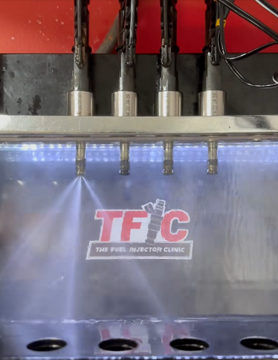
In the image: screenshot from the video.
As we see, the injector injects fuel “on full throttle”. In such a situation, HPFP will not be able to pump the Rail pressure, and absolutely definitely – there will be error messages regarding it, too. Yes, this time – 100% confirmation that such a defect is possible/happened, but it is extremely rare!
One more nuance, which I would like to mention. It is necessary to distinguish between an injector getting stuck in the open position and a dripping injector.
On the internet, I found a test method of one reputable blogger:
a. warm up the engine;
b. connect the computer, check the Rail pressure;
c. switch off the engine, continue to monitor the Rail pressure.
If the pressure stays unchanged or increases (because the fuel in the Rail warms up), everything is fine. If the pressure drops – the injector is stuck.
Not true. If the pressure drops after switching off the engine, the culprit can be (if we discard the fuel leakage in the engine compartment):
a. HPFP. Even more, for example, for N20 engines in upgraded HPFP, there was a special borehole to drop the pressure after shutting down the engine (to avoid the fuel from dripping into the crankcase);
b. one of the injectors is dripping. Such dripping is typically incomparably smaller (hundreds of thousands/million times) than leaking in the open state. For this reason, these two cases should be separated.
Yes, such a dripping is not desirable and has to be solved as soon as possible, but it typically is not so critical for the performance of the engine. Such dripping causes the most damage to the oil, as it flows into the crankcase after the engine is switched off.
