This time – a longer entry regarding one interesting case. Interesting, but not unique.
I will not drag on – here is the post of the owner of the vehicle in the FB interest group:
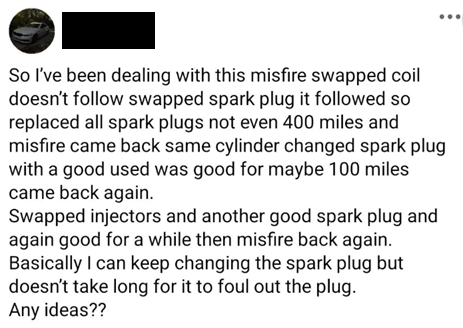
What is interesting in this entry? The owner of the car replaced all the hubs of the specific cylinder:
a. ignition coil;
b. spark plug;
c. injector.
And still misfires return exactly in this cylinder! How is that possible?
Here is the list of error messages:
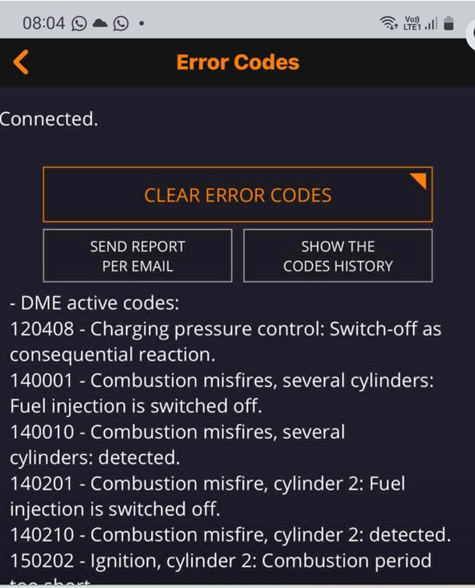
What do we see in this image?
a. We see misfires in cylinder No.2. Typically, there have been misfires in “several cylinders”, after which the shutdown of the injection of a specific cylinder and turbo compressor followed. From where did “several cylinders” appear? Bosch DME has problems identifying the misfires precisely (old story regarding Siemens patent).
b. More interesting topic – we see an error message 150202. This problem of shortened/zero ignition time is detected correctly – DME measures it directly, on the output of the ignition IGBT switch. Due to this reason, this time I really believe that the problem is exactly in the 2nd cylinder. Short circuit in the ignition coil or spark plug? But both hubs have been replaced!
Slightly stepping back, we see MHD “tuning”. Obviously, an ethanol sensor, custom maps, and a more powerful HPFP are installed – everything for a proper BMW lover.
Significantly, DME has not recorded a single error message regarding fuel mixture and air mass (typically error messages 118001, 118401, and 101F01). Yes, in the event of a shortened/zero ignition, DME immediately detects the problem and switches off ignition of the damaged cylinder. No white smoke and stories regarding “injector stuck in open position”.
Let’s return to the basis problem – what is going on here?
Here is the picture of the spark plug:
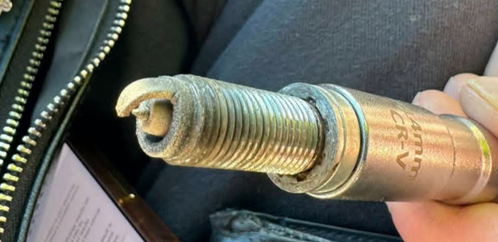
Oh, abnormal carbon coating! Reasons for this problem:
a. low temperature of the spark plugs (too slow and peaceful driving) and not using the spark plug cleaning procedure (for example, I clean the spark plugs after each 5000 km). True thou, this is almost a new spark plug, not using the cleaning procedure will not be to blame.
b. lean fuel mixture. Yes, this version is confirmed by the very light color of the insulator. The fuel mixture is too lean! How so?
The lean fuel mixture can be:
a. in all cylinders;
b. in some/individual cylinder.
To detect the average fuel mixture of all cylinders, we would have to use an external exhaust gas/Lambda meter. Unfortunately, such tools are quite rare (because they are expensive enough) – in any case, they are not available for a “regular” user. This time, the problem with misfires is pronounced in one cylinder, “follows” the spark plug. This time, the average fuel mixture will not be to blame. Yes, it is possible that the average fuel mixture, too, is far from ideal, but other cylinders somehow are “dealing” with it.
Obviously, a strongly lean fuel mixture is exactly in this (2nd) cylinder! But the injector, too, was replaced!
Logical conclusion – the fuel mixture (injector) adaptations of the specific cylinder are to blame. What happened to them?
In other blog entries, I have mentioned that these (Bosch) DMEs have problems with misfire detection. As a result, the wideband probe is flooded, and the adaptations of the specific cylinder (and even common ones) are demolished. That’s why it is critically important to readapt the engine after EACH repair! Yes, also a harsher misfire crash without replacement of the components corresponds to this status.
OK, let’s assume that the owner of the car has not done the readaptation of the engine after a previous misfire crash of the 2nd cylinder. Yes, that would explain all the problems. But aren’t there other nuances we should check for?
There are! The owner of the car has added a data log. Let’s check it!
Let’s check the total fuel mixture. Low/zero required torque:
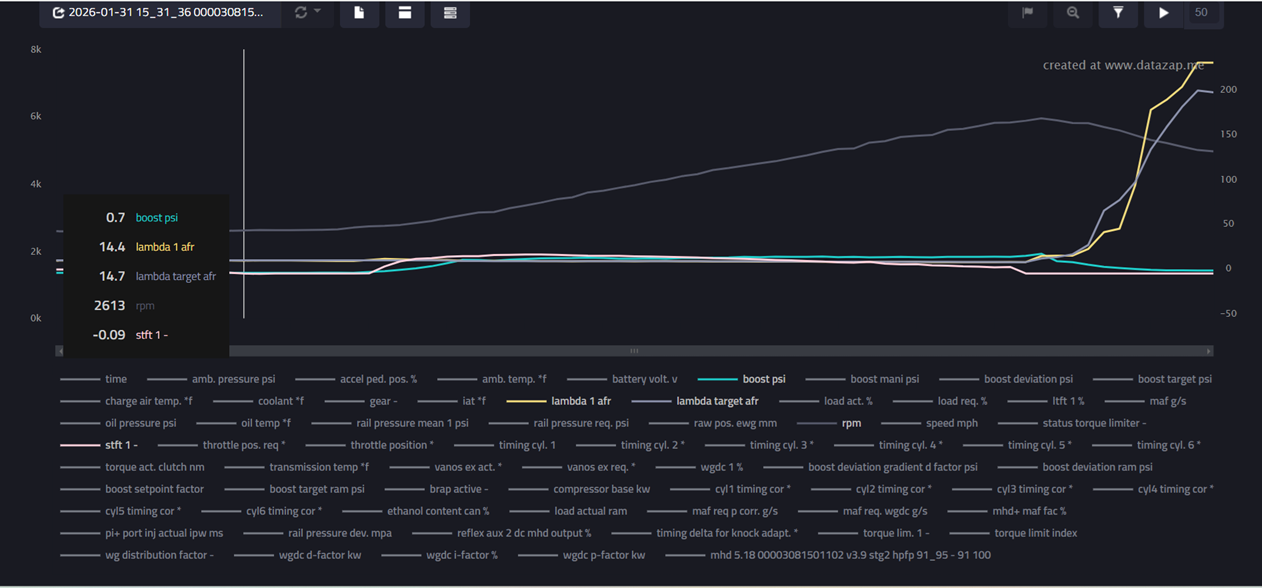
Everything looks perfect. STFT – very close to zero/ideal.
And here – mode of full required torque:
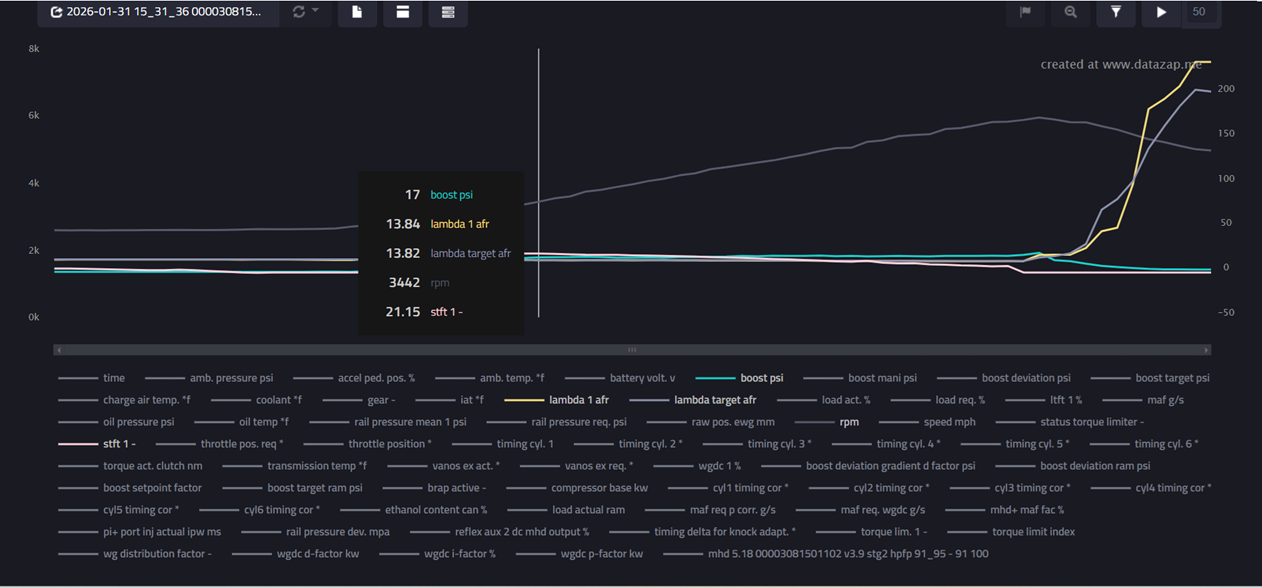
STFT around +20%! A lot! It is very much! It means that the DME prognosis has failed harshly! And also in the long term (this is not the first spurt of the car owner) are not fixed. Why so?
Here, the answer is simple: “tuning”. Even more, there are several causes of the problem:
a. changing part of the management maps (no “normal” tuner would change all required maps, that would be a huge amount of work, which requires knowledge and equipment of the manufacturer), the differences between the desired and the actual values are appearing;
b. several/switchable maps only exacerbate the problem. DME has common adaptations, but it has not intended such switching;
c. addition of ethanol to the fuel creates additional problems. Not even talking of additional port injection modules and other additions. All this paralyses the normal performance of the DME;
d. finally – performing even one of the previously mentioned, DME is not able to normally use the energetic module simulations. What is that? DME analyses each power cycle of each cylinder, calculates its energy, used air, and fuel. Continuously analyzes indications of all sensors; uses these data to simulate the real-time engine performance. Such a principle helps to efficiently predict the performance in swiftly changing conditions, identify “lying” sensors or not perfectly working actuators. Intervention in management maps destroys this simulation tool. Many functionalities are switched off. Many adaptations – their creation is paralysed. Many component/performance tests – switched off.
The engine’s performance is close to that of the M54.
Here, confirmation of the previously mentioned:
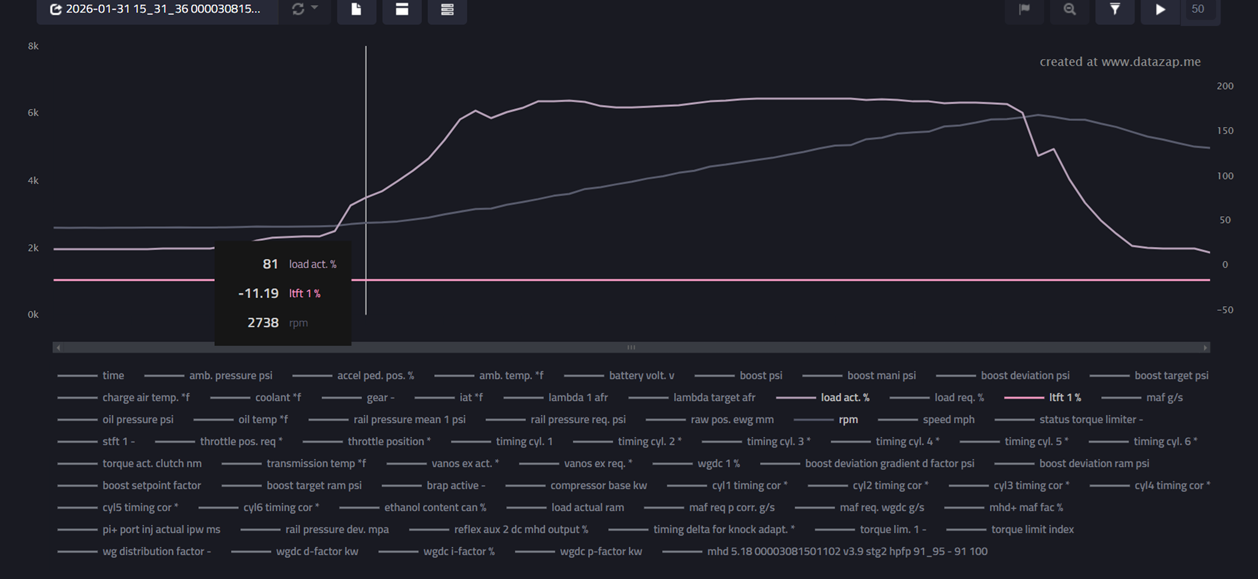
Pay attention to the LTFT. Indications of the LTFT are a line! Despite the changing RPM and the changing required torque! In addition, the absolute value of the LTFT is far from zero (ideal). Here we clearly see two things:
a. The modifiers of the management maps have not “hit the target”;
b. creation of the LTFT is COMPLETELY paralysed/stopped!
If DME does not perform the creation of the common LTFT adaptations, then it also does not create more “finer” adaptations. For example, creation of the injector adaptations (normally these, as the common fuel LTFT, are multi-dimensional maps. These maps include temperature, required torque, Rail pressure, RPM, fuel quality indications, and many other parameters).
Now, there is another topic worth mentioning.
In these engines, the LSU 4.9 ADV wideband probe is used. Significant nuance of this probe – its indications depend on the exhaust backpressure. DME, using the exhaust pipe model, calculates the exhaust backpressure and corrects the readings of the probe. If the “tuning” is performed and the CO catalytic converter is “amputated” (not talking about other modifications of the exhaust), of course, the backpressure changes. Is the new situation taken into account? Of course, no.
Second nuance: the control probe is used not only to analyse the performance of the CO catalytic converter, but also to control and trim the wideband probes. If the CO catalytic converter is “deleted”, the control probe is not able to correctly perform its (trimming ) task. If this probe is “deleted” too, there is nothing that can trim the wideband probe! Yes, no error messages appear, because they (including a significant part of the DME functionality) are deleted. Something is regulated, something is corrected, but the fuel mixture is far from correct (especially in transition processes, when STFTs are not able to help). Such an incorrect common fuel mixture can be the reason for the initial misfires (which is the cause of the demolition of all adaptations and such “unsolvable” problems).
Let’s see what is happening with the ignition topic:
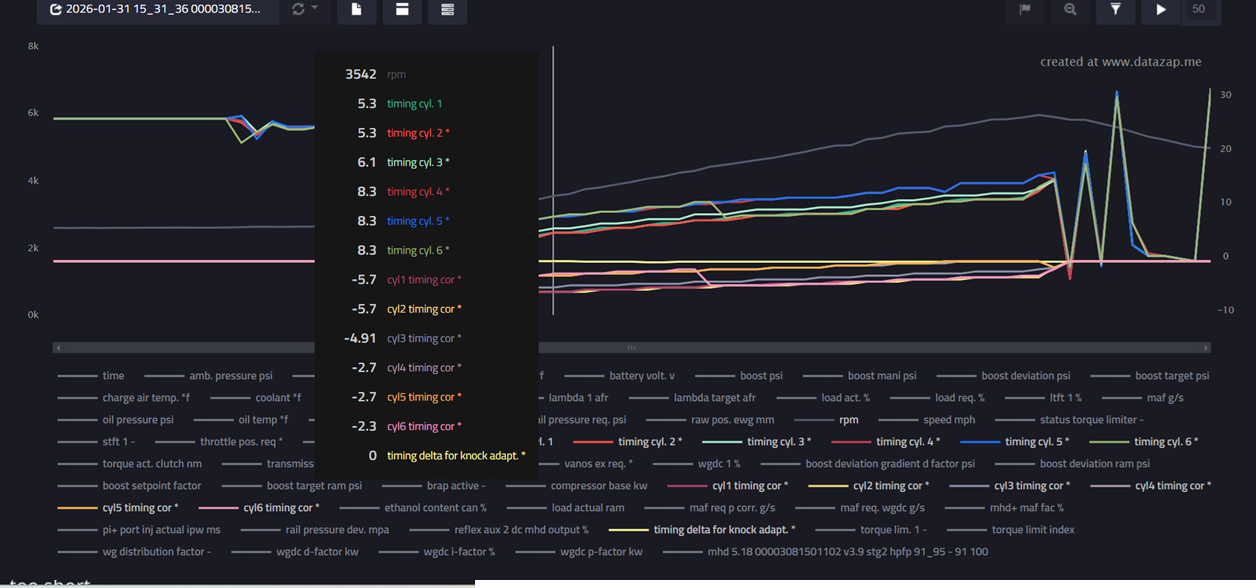
We see that the ignition moment of all cylinders is similar; no significant short-term ignition correction due to increased detonation/knocking can be seen. According to the graph, there is a feeling that the ignition of cylinders is created in two versions: “earlier” and “later”. Yes, this is strange. Obviously, DME does not really see the knock sensors. Ignition management is even simpler than for 25+ years of senile DME. Stop. What is that? Common (long-term) knock adaptations are zero in the entire range of RPM! How so? Well, obviously, “tuners” have switched off this functionality. Or – it has switched off as a result of “correct” tuning.
This does not surprise – of course, when using a different fuel, its combustion properties will be significantly different. It would be correct to create adaptation maps for each fuel type. But, as it is not possible, then – let’s switch adaptation off altogether! Is that rude? It is VERY rude! Such a “solution” means harsh knocking in transition processes; harsh knocking at the beginning of stationary processes (until short-term corrections can correct the ignition). Yes, here we don’t have to wonder that the pistons, cranks are getting “tired”, the bearing shells are getting damaged.
I noticed one more nuance:
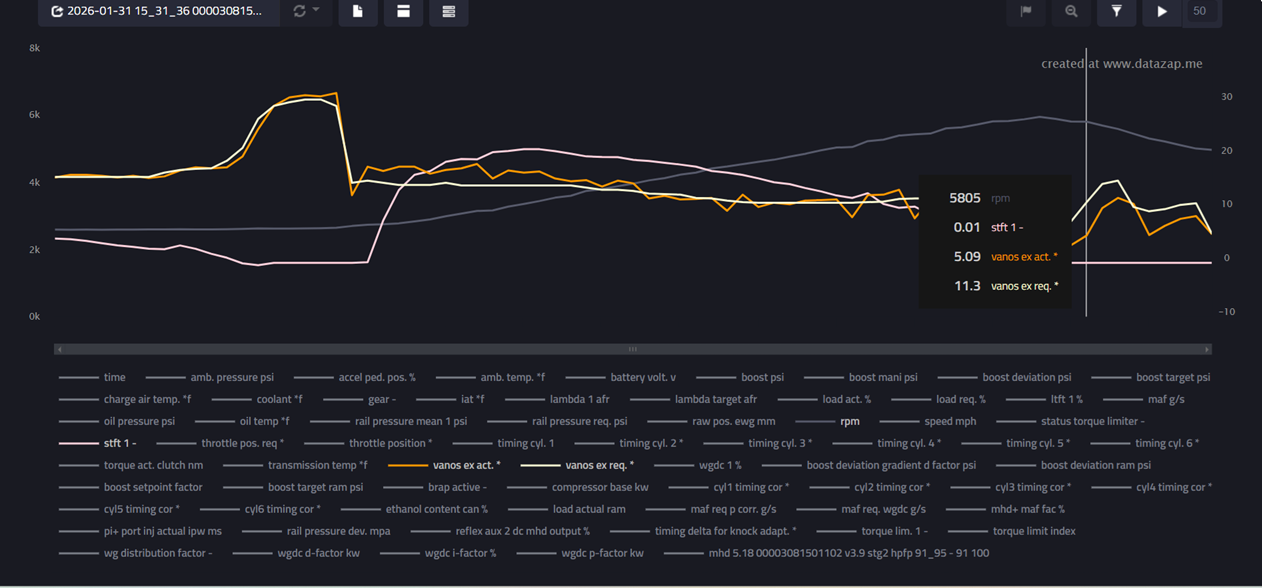
In this graph – required and detected position of the exhaust VANOS. In the overrun mode, we see a long, permanent difference of around 6 degrees. Also, at the beginning of the spurt, the permanent difference reaches around 4 .. 5 degrees. It is a lot! The actuator of the exhaust VANOS is clogged! This problem creates uneven performance of the engine (it will be more pronounced for a cool engine), which can be the cause for initial misfires (which later create all previously described problems). The actuator, of course, should be replaced.
Please, understand me correctly. I do not say that the MHD can not be used. If you build a drag car or a sports car, it is possible that such a solution will be fine. The money earned in a drag race may be incomparably greater than the costs of the engine repair, but you struggle with these “unsolvable” problems.
But you have to understand – if you turn a complicated engine management into a “vegetable”, switch off all possible protection mechanisms, switch off the adaptations: “the piece of iron” will perform accordingly. Such DME has left several % of intended “mental abilities”; in addition, the user does everything possible (by changing fuel, management maps), to paralyse even this limited “thinking”.
Yes, unfortunately, there is no free cheese (if only in the mouse trap). If you want to be smarter than the manufacturer, you will have to endure the side effects.
In conclusion, will the deletion of adaptations and readaptation of the engine help this time? Regarding the problem of cylinder No.2, it should help. But, it should be clear that such/similar problems will repeat. Much depends on the consistency of the injector parameters. If the initial parameters are similar, the situation will be better. If the initial parameters differ more, misfires in some cylinders will be unavoidable. To fundamentally solve the problem, the stock software and hardware should be restored.
P.S. continuation is intended for situations, if/when the readaptation of the engine does not help. Why can it happen?
a. even with a correct/stock software, pressing the button “delete all adaptations”, actually, the largest part of the adaptations IS NOT deleted! A logical question – why so? I/user had all the adaptations deleted! The reason is as follows – if the DME deletes all adaptations, the next start will be a complete disaster, and creation of new adaptations will be a long and harsh process. For readaptation to happen as easily and quickly as possible, DME chooses adaptations (hubs) that it can “trust”. Adaptations of the trusted hubs are not deleted immediately. They are just given priority for accelerated restoration. Part of the hubs are marked for immediate readaptation. For example, for MSD80/81/87 and other management units, which use piezo injectors, there was an argument by which the injector adaptations were filtered as reliable or unreliable. If the user encoded new/different codes of the injectors in the DME memory, it was clear that the old adaptations of the injectors had to be deleted! Unfortunately, B58 uses injectors without encoding data; accordingly, there are no criteria by which to detect whether the injectors are/are not replaced, and their adaptations can/can not be trusted. Only on the go (by condition – DME works as intended by the manufacturer) – if DME notices significant oddities in the injector behaviour, it can choose to delete the injector adaptations immediately, not restore in routine order. Exact conditions are known only to the manufacturer.
b. if the software is modified, part of its functionality is paralysed (and this is exactly the case), adaptation processing conditions are completely unclear and unpredictable. Equally unpredictable (I will be even more pessimistic – almost impossible) is the creation of new and correct adaptations.
How to act if the readaptation of the engine does not give the result, and there is a reason to believe that the old adaptations of the injectors continue to “mess with the mind”.
Next step – “flashing” of DME in all possible ways. The quick one; the full one – trying out all possible options; flashing in of some older release, then back to the newer one. All kinds of experiments in this area. There is no other way to call this process, because no one (outside the manufacturer’s development team) knows where the adaptation status bits are located, what their meaning is, or which/where/why adaptations are deleted.
To make sure how the “damned” 2nd cylinder performs after the “repair” and if all problems are solved, the mechanical efficiency of cylinders should be checked/compared in all possible driving conditions. It should be done in ISTA/Expert mode.
