This time, I’m describing a really unique defect of the injector. This is the first such defect since I’m performing diagnostics of BMW engines. The problem was identified for my (now the spare) E60 vehicle.
In this entry: no unnecessary images, only concise data.
Symptoms of the defect.
Cold start in winter (with temperatures down to -25 °C) – perfect. A partially and completely warmed-up engine performs perfectly, and uses a Stratified charge.
Cold start at this moment (spring, outside temperature around +5 °C) was far from perfect. Directly after starting, a permanent vibration of the engine in idle appeared. One of the cylinders was on the verge of switching off, but the Check engine light lit up only after longer torture of the engine (only in several from 10+ cold starts, engine running in idle for several minutes). When the engine warmed up partially, the problem unexpectedly disappeared, and the engine performed correctly until the next cold start.
Diagnostics.
In the error message list, a switched-off 2nd cylinder was listed. In the typical scenario, we would assume that the injector of the 1st or 3rd cylinder, or both of them together, is/are leaking. But – this was not a typical scenario.
Checking the Rough run data, I could clearly see that the 2nd (by placement) cylinder is lazy. Mechanical energy of the second cylinder was 40 .. 50% lower than for the other two cylinders of the same bank. But, contrary to the expectations (Integrator significantly <0, which would confirm the leaking of the injector), the integrator of the 1st bank was +15 .. 20%! How so?
Checking the injector data, I had to conclude:
a. results of the chemical tests (including data of the cold start) – correct for all injectors;
b. data of the chemical tests in Stratified charge (flow rate adaptations) for all injectors – correct;
c. data of mechanical tests in Stratified charge, idle – correct. None of the injectors is leaking, atomization of all injectors – correct;
d. all bank adaptations (including Offset) – correct;
e. electrical parameters of the injectors (reached voltage, supplied energy) are correct even when the vibration in idle is felt.
f. misfire long-term counters have counted 175 (!) units for the 2nd cylinder.
What happened to the first bank? Completely incorrect injector adaptations? In theory, a possible scenario. It can happen that some cylinders have misfires, which is why DME created incorrect adaptations (chemical or mechanical tests failed).
To check this assumption, I deleted all adaptations. Started the engine in open loop mode. Despite this, the 2nd cylinder was still lazy! At this moment, no smallest doubt was left – the problem is exactly in cylinder No.2.
Very low possibility – defect of the ignition system. One in a million, but – it has to be checked. Even more, if the ignition coil can be replaced in one minute, it involves unscrewing two screws from the decorative engine cover. Unfortunately, replacing the ignition coil did not yield any results.
The only possible culprit was now 100% confirmed – it is the injector. Obviously, at the exact temperature, the injector either opened partially or its opening was significantly delayed. I discarded a version of very poor atomization, because in idle, there is a lot of time for the fuel to mix with air. Even very poor atomization in idle can not reduce the efficiency of the cylinder by 40 .. 50%! Instead, partial opening in this case is very specific, because this time, electrical problems of the injector were not observed (until now, I have encountered defects, when the contact between piezo elements is partially lost, but then the injector indicated reduced energy consumption/increased voltage reached).
Replacement of the injector solved the problem. Here, which injector was the culprit of this exotic defect:
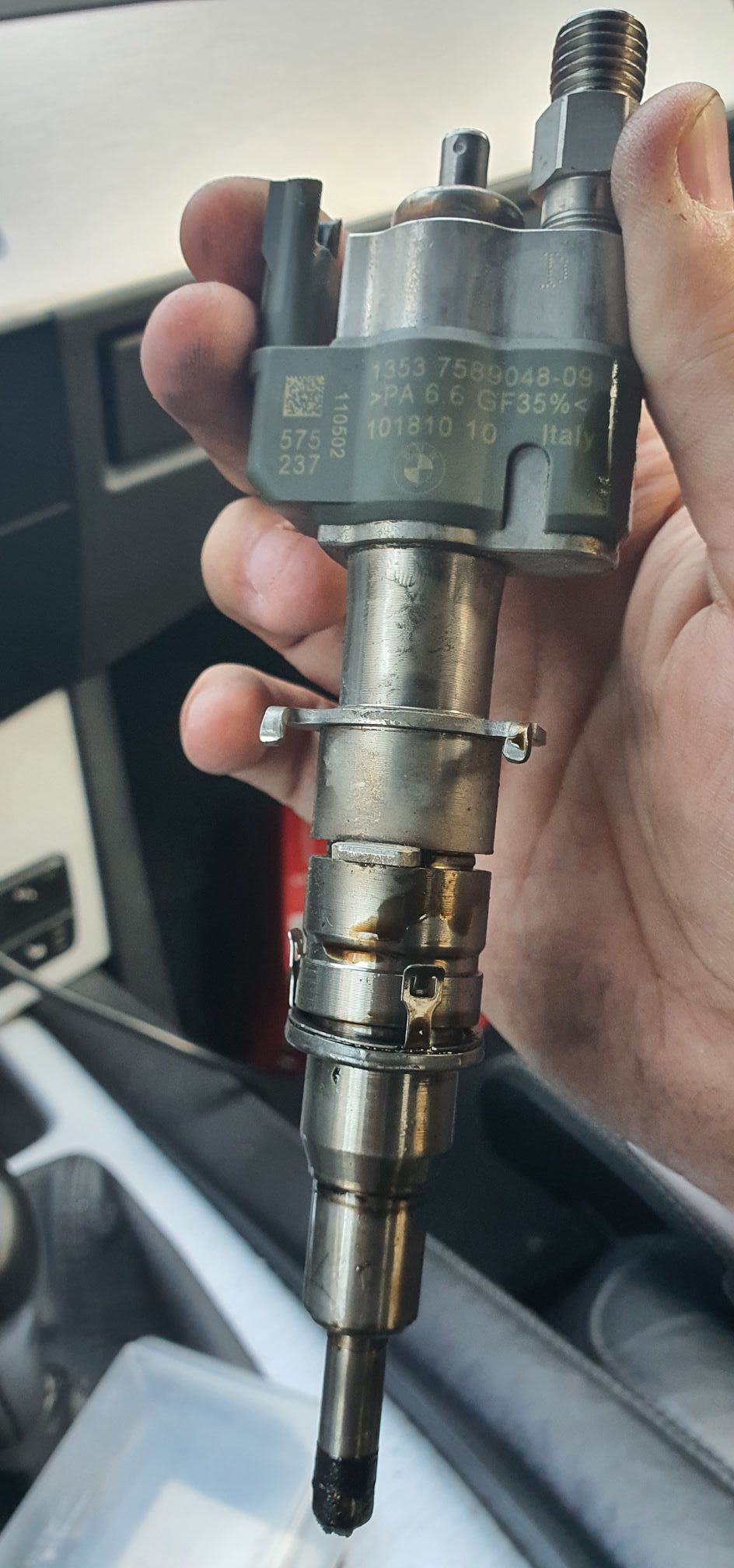
As you can see, this is a 15-year-old injector of the 09 release.
This injector was installed by mileage 50.000 km by the first owner of this car in Germany. This injector was in use all this time, until now (Year 2026). Now the mileage of the car is around 800.000 km. So, the injector has successfully served for 750.000 km! An impressive resource!
It is possible that in this case the mechanical wear of the injector is to blame. In any case, this time it would not be appropriate to blame the engine manufacturer.
